Something is happening in online education that most program directors already sense, even if it hasn’t yet been named clearly enough.
Courses are running. Assignments are being submitted. Grades are being issued. And yet, when you ask the harder question — did learning actually happen? — The honest answer is: we don’t really know.
This is not a technology problem. It is not primarily an academic integrity problem. It is a structural problem that has been building for years, and that now demands a direct response.
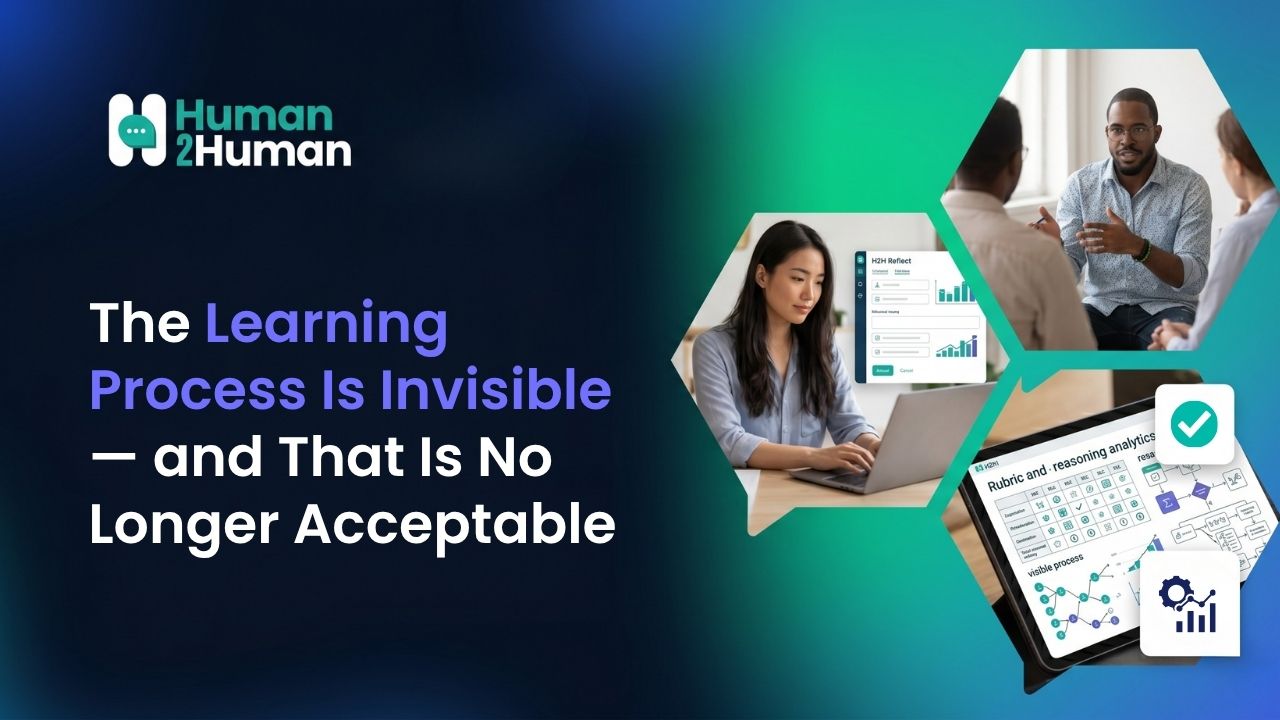
The learning process, in most online programs today, is rather invisible.
The data we have — and the data we need
Online universities and program teams have become very good at measuring the surface of learning. Completion rates, submission timestamps, quiz scores, and final grades are tracked reliably by most LMSs and reported with confidence.
But these metrics describe outputs. They describe whether something was submitted, not whether anyone actually thought about it.
What remains hidden — almost entirely, in most online programs — is the process that sits between a learner opening a module and submitting an assignment. Did they wrestle with a difficult idea, or copy the first plausible answer they found? Did they revise their initial position when confronted with new information, or simply fill in what was expected? Did they engage with the material, or move through it as efficiently as possible with minimal cognitive effort?
These questions are not abstract. They are the difference between a program that produces genuine understanding and one that produces the appearance of it.
For most of the history of online education, institutions accepted this invisibility as an unavoidable trade-off. The tools required to make thinking visible at scale simply did not exist. So programs measured what they could measure — outputs — and trusted that the process was happening somewhere behind them.
That trust can no longer be assumed.

Why the invisible has become the urgent
Two forces have converged, making this problem impossible to defer.
The first is generative AI. Written assignments, discussion posts, and reflective journals — the instruments that most online programs still rely on to evaluate learning in online settings — can now be produced in seconds without any engagement with the material. The outputs look the same. The process behind them is absent. Institutions that continue to evaluate learning by reviewing submitted documents are, increasingly, evaluating the output of a tool, not the thinking of a learner.
This is not a disciplinary problem that stricter policies can solve. It is a design problem. When the primary evidence of learning can be generated without learning, the evidence has stopped working.
The second force is more structural. As online programs have grown in scale, the feedback loops that once made engagement visible have eroded. In small seminars and in-person cohorts, instructors develop an intuitive sense of how learners are engaging — who is genuinely working through the material, who is performing compliance, who is struggling productively, and who has quietly disengaged. At scale, asynchronous and online environments strip away almost all of those signals. What remains is completion data and grades: the least informative measures of the most important activity.
The result is what might be called a data desert at the heart of online education. Institutions can see that learners have passed through a program. They cannot see how.
What this means for institutional credibility
The invisibility of the learning process is not only a pedagogical concern. It has direct consequences for institutional trust, credential value, and competitive differentiation — the things that program directors are responsible for protecting.
When the process behind a credential cannot be observed or verified, the credential itself becomes difficult to defend. Employers who hire graduates from online programs are already asking harder questions about what those credentials actually represent. Accreditors are scrutinizing evidence of learning outcomes with increasing rigor. And learners themselves — who are paying real money for these programs — are asking whether the experience they received was worth what they paid.
Programs that cannot answer these questions with confidence are vulnerable. Not because their content is weak, but because the evidence of what happened inside their courses is thin, unverifiable, and increasingly easy to question.
In a competitive market where learners can choose between many online options with similar content, this is no longer a secondary concern. When the learning experience feels passive, generic, and unverifiable, programs become interchangeable. And interchangeable programs do not retain learners, attract strong cohorts, or build reputations that compound over time.
What making thinking visible actually requires
The solution is not better detection tools. Plagiarism detectors and AI-identification software look at outputs after the fact and try to infer what happened during the process. They are managing a symptom, not resolving the underlying condition.
Making thinking visible requires a different kind of design — one in which the learning activity itself generates meaningful evidence as it happens.
This means moving away from assessments that ask learners to produce a polished artifact at the end of a learning sequence, and toward activities that require learners to reason in real time. To respond to something dynamic. To articulate a position, encounter a complication, and revise. To engage with a peer’s perspective and defend their own.
These are the conditions under which genuine thinking becomes observable — not as a document to be reviewed, but as a live process that leaves a meaningful record.
It also means accepting that deep thinking is inherently social. Much of what we understand most durably is because we were required to explain it to someone else. Because a peer’s challenge forced us to sharpen our reasoning. Because articulating a position out loud revealed that we understood it less than we thought.
Asynchronous content consumption, however well-designed, cannot replicate these conditions. It produces passive learners who are alone with the material. The interaction and friction that produce deep understanding are absent by design.
Making thinking visible, then, requires solving two problems simultaneously: making the individual reasoning process observable, and making genuine peer interaction real — not performative, not fragile, but structured, consistent, and scalable.
Where Human2Human fits in
Human2Human was built specifically to address these two dimensions.
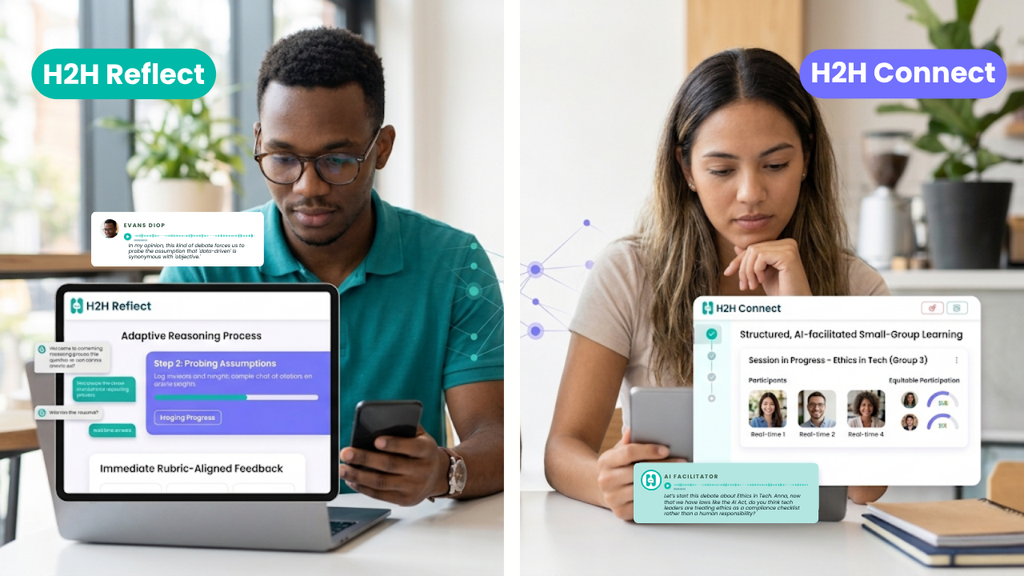
H2H Reflect addresses the individual reasoning problem. Rather than asking learners to submit a written response that requires no real engagement, H2H Reflect guides each learner through a live, adaptive reasoning process. The AI facilitator activates prior knowledge, probes assumptions, introduces complications that require the learner to revise their thinking, and responds to each contribution in a way that is highly impractical to shortcut with generic AI tools. The process unfolds in real time, and the record it generates is a genuine transcript of how the learner actually thought through a problem — not a document whose origins are impossible to trace. Upon completion, learners receive immediate, rubric-aligned feedback. Program teams receive clear evidence of reasoning quality, engagement, and conceptual understanding at both individual and cohort levels.
H2H Connect addresses the peer interaction problem. It replaces fragile forum participation and unreliable breakout sessions with structured, AI-facilitated small-group learning that actually delivers on the promise of peer exchange. Scheduling, group formation, and reminders are handled automatically. During the session, an AI facilitator ensures equitable participation, keeps the discussion substantive, and elicits genuine contributions from every participant. No one dominates. No one disappears. The result is seminar-quality interaction — the kind that produces real understanding — at a scale that no institution could replicate through human facilitation alone. And crucially, the interaction itself becomes the evidence: a structured, auditable record of how learners engaged with ideas and with each other.
Together, these two tools shift what online programs can actually see. Not just whether a learner submitted something, but how they reasoned. Not just whether a discussion occurred, but whether it was substantive. Not just completion, but understanding.
The question worth asking now
The programs that will lead online education in the coming decade will not be the ones that defend the old model with better detection tools. They will be the ones who ask a more fundamental question: what would it actually mean to know that our learners learned?
The answer to that question is not a new version of the essay assignment. It is a redesigned learning experience — one in which reasoning is visible, interaction is real, and the learning process itself leaves a record that institutions can stand behind.
That is what online education always should have been. The tools to make it possible now exist.
The only remaining question is whether programs will choose to use them.
Do you want to learn and explore more about Human2Human.ai? Contact us.