
Accessibility Statement
Last Updated: 30/01/2026
At Human2Human.ai, we are committed to making our platform accessible and usable for as many people as possible. We believe that meaningful human‑to‑human learning should be inclusive by design, and that accessibility is a fundamental part of delivering equitable, high‑quality learning experiences.
This Accessibility Statement outlines our current accessibility approach, the standards we align with, known limitations, and how users can request support or accommodations.
Our Accessibility Commitment
Human2Human is designed with accessibility in mind across its core learning workflows. We prioritize functional accessibility to ensure that all learners and educators can participate in, design, and benefit from AI‑facilitated group learning activities, regardless of the input method or assistive technology they rely on.
Accessibility is an ongoing effort, and we continuously work to improve the experience as the platform evolves.
Target Accessibility Standard
Human2Human aims to align with the Web Content Accessibility Guidelines (WCAG) 2.2, at the AA conformance level, as published by the World Wide Web Consortium (W3C).
Our focus is on meeting WCAG requirements that are most critical to learning participation, content comprehension, and equitable interaction within group activities.
Accessibility Features and Practices
The following practices are implemented or actively maintained across the platform:
Keyboard Accessibility
All primary user flows are designed to be operable using a keyboard only, without requiring a mouse. This includes:
- Account registration and login
- Creating and scheduling activities
- Joining learning sessions
- Participating in text‑based learning activities
- Viewing assessments and feedback
- Accessing previous activities
- Navigating educator and learner dashboards
- Basic navigation of analytics views
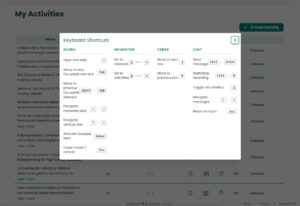
Semantic Structure and Assistive Technology Support
Pages follow a logical heading hierarchy (H1–H3)
Form fields are associated with descriptive labels
Interactive elements use appropriate semantic HTML (e.g., buttons, links)
These practices support screen readers and other assistive technologies.
Visual Design and Contrast
Text and interactive elements are designed to meet WCAG AA color‑contrast requirements
Focus states are visually distinct to support keyboard and low‑vision users
Multiple Interaction Modalities
Human2Human supports text‑based interaction as a core modality. When voice‑based interaction is available, text interaction remains fully supported as an accessible alternative, ensuring that learners can participate regardless of audio or speech constraints.
Known Limitations
While we strive for broad accessibility, some areas of the platform may not yet fully meet all WCAG 2.2 AA criteria. Examples may include:
Advanced analytics or visualization components that are still being improved for screen‑reader support
New or experimental features that may require additional accessibility refinements
We document and prioritize these limitations as part of our ongoing development roadmap and work to address them over time.
Conformance Reporting
Human2Human maintains a Voluntary Product Accessibility Template (VPAT) aligned with WCAG 2.2 to document our current level of support and known gaps. This document is available upon request.
Feedback and Accommodation Requests
We welcome feedback on the accessibility of Human2Human. If you encounter accessibility barriers or need an accommodation to fully participate in a learning activity, please contact us:
Email: accessibility@human2human.ai
Please include a description of the issue, the page or feature involved, and the assistive technology or browser you are using, if applicable. We will make reasonable efforts to respond and provide support in a timely manner.
Continuous Improvement
Accessibility is not a one‑time effort. As Human2Human grows, we remain committed to improving accessibility through:
Regular reviews of core user flows
Accessibility testing tools and manual checks
Feedback from users, partners, and institutions
Our goal is to ensure that Human2Human continues to support inclusive, responsible, and effective human‑to‑human learning at scale.