The problem with peer learning online isn’t the idea. It’s the delivery model — and why it fails the moment programs start to grow.
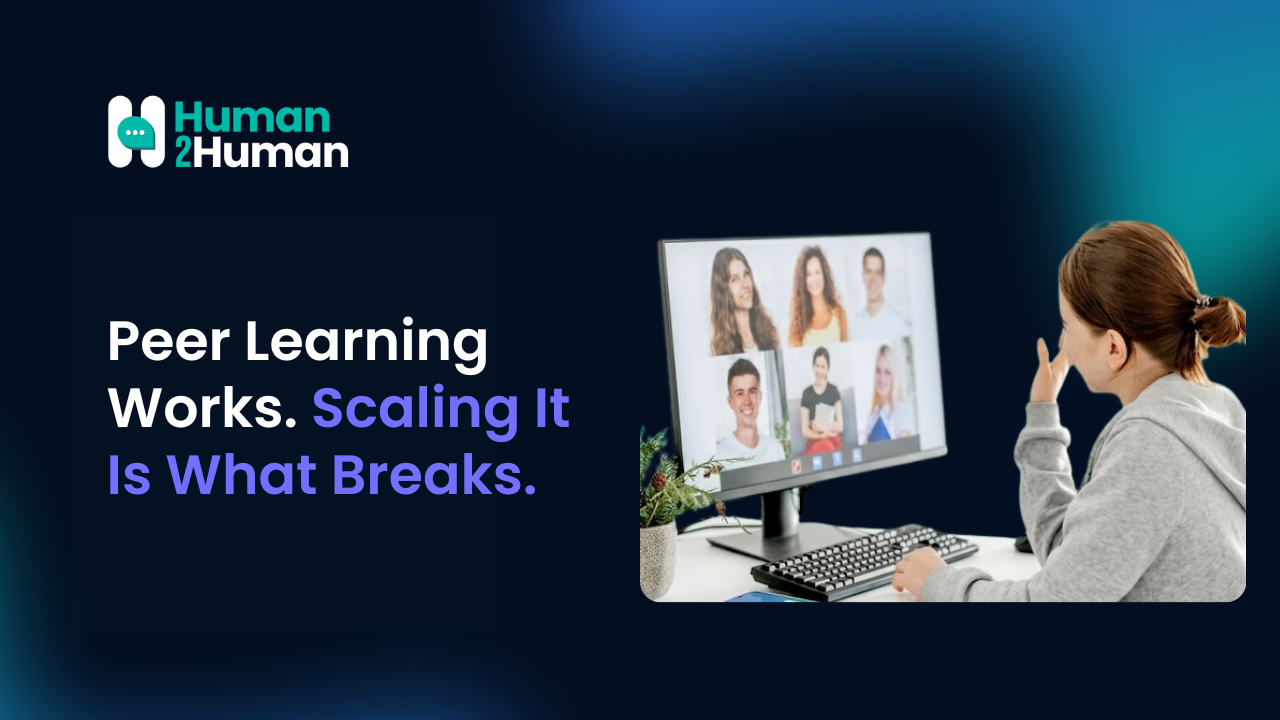
Ask any learning scientist about peer learning, and they will tell you the same thing: it works. When learners engage with one another — discussing ideas, challenging assumptions, explaining concepts back to each other, navigating disagreement — something happens that passive content consumption simply cannot replicate. Retention improves. Critical thinking deepens. Communication skills sharpen. People develop the kind of perspective-taking that prepares them for real professional environments.
The research is robust. The principle is sound. And yet, in most online programs, peer learning quietly underdelivers.
The common reaction is to conclude that peer learning just doesn’t translate well to online environments. That people are too scattered, too busy, too disengaged. That it’s a nice idea that belongs in a campus seminar room, not an asynchronous course.
That conclusion is wrong. The problem isn’t peer learning. The problem is the delivery model — and what happens to that model the moment you try to scale it.
What Peer Learning Actually Looks Like When It Works
In small, high-touch settings, peer learning can be genuinely excellent. A skilled facilitator brings a group of six learners together around a real case or problem. The structure is clear. The facilitator monitors participation, redirects when discussions drift, draws out quieter voices, and keeps the group accountable to a learning objective. At the end, they have a reasonable sense of who engaged meaningfully and who didn’t.
This model works. It is also, by design, expensive, slow, and impossible to replicate across a program with hundreds or thousands of learners.
So what happens when programs try to grow?
Two Ways the Model Breaks — and Why Both Fail
Faced with the challenge of scaling peer learning, most institutions make one of two choices. Neither works particularly well.
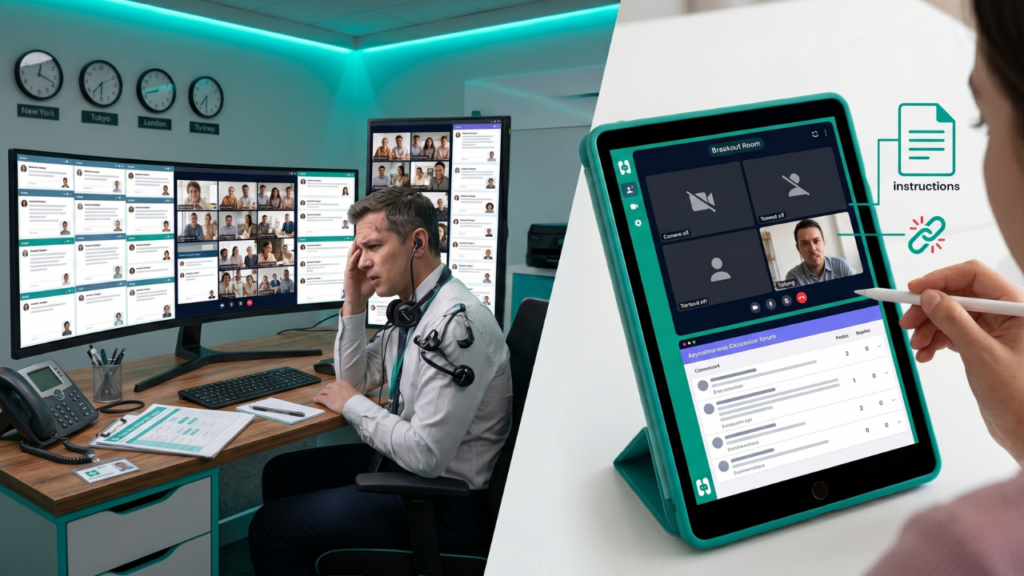
The first path: multiply the facilitators. Hire more staff, train more moderators, run more small groups. The learning quality can stay high, but the costs rise steeply and quickly. Coordination becomes a logistical nightmare — scheduling across time zones, managing no-shows, ensuring consistency across dozens of facilitators who each bring their own interpretation of the activity. What was once a controlled, high-quality experience becomes variable and expensive to maintain. And as cohorts grow, the model becomes structurally unsustainable.
The second path: remove the facilitator. Give learners instructions, put them in breakout rooms, and hope for the best. The results are predictable. Without structure and real-time guidance, participation becomes uneven. Some learners dominate; others disengage and coast. Conversations drift from the learning objective or stall entirely. Staff struggles to monitor quality across simultaneous groups. Assessment becomes inconsistent or essentially meaningless.
What starts as peer learning ends up being an awkward exercise that learners find frustrating rather than valuable — and instructors find impossible to evaluate fairly.
Facing these trade-offs, many programs make a third choice: abandon structured peer interaction entirely and replace it with asynchronous discussion forums. Everyone posts a response. Everyone comments on two classmates’ posts. The boxes get checked. Meaningful discussion rarely happens.
This is the quiet failure at the heart of online peer learning today. Not a dramatic collapse — a slow retreat into formats that are manageable but hollow.
Why This Has Become Urgent
The stakes around this problem have risen considerably.
Generative AI has made it easier than ever to produce the surface signals of learning without doing the underlying work. Written assignments can be outsourced in seconds. Asynchronous forum posts — already low-signal evidence of engagement — can now be generated without any real thinking at all. The thin proxies that programs have relied on are becoming thinner by the day.
At the same time, learners’ expectations are shifting. In a world where content is abundant and often free, the value proposition of a structured learning program increasingly rests on what content alone cannot provide: interaction, connection, real-time challenge, and the kind of network-building that only genuine human exchange can build.
Peer learning — done well — delivers exactly that. It produces evidence of authentic thinking that is far harder to fake than a written submission. It creates social accountability, keeping learners engaged and present. It builds the collaborative skills that employers consistently say matter most.
The programs that figure out how to deliver this reliably and at scale will have a genuine differentiator. The ones that fall back on forum posts will not.
The Core Problem Is Orchestration
If peer learning works in small settings but breaks at scale, the question worth asking is: what specifically is breaking?
The answer isn’t motivation, technology, or learner attention spans. It’s orchestration — the set of systems and structures that need to function reliably across many learners, cohorts, and sessions simultaneously.
Getting that right requires solving a chain of interconnected problems:
Scheduling and group formation need to be self-service and automated, without requiring staff to manually match learners, field rescheduling requests, or send reminders. The coordination overhead alone kills many peer learning programs before they even start.
The activity itself needs a clear pedagogical structure that learners can follow without a human facilitator walking them through every step. Vague instructions and open-ended prompts produce vague, open-ended conversations.
Real-time facilitation needs to happen inside the session — not as a PDF of guidelines the learner skimmed before logging on, but as live, adaptive guidance that keeps the group on task, ensures everyone participates, and responds to what is actually happening in the room. This is the hardest part of the problem. And it is the part that AI can now meaningfully address.
Finally, evidence needs to be captured automatically during the session — not reconstructed afterward from memory or spot-checked through manual review, but produced as a natural byproduct of how the activity is run.
Fix those four things, and the model that works in small settings can scale. Leave any of them unaddressed, and the whole thing falls apart in the ways described above.
What a Better Model Looks Like
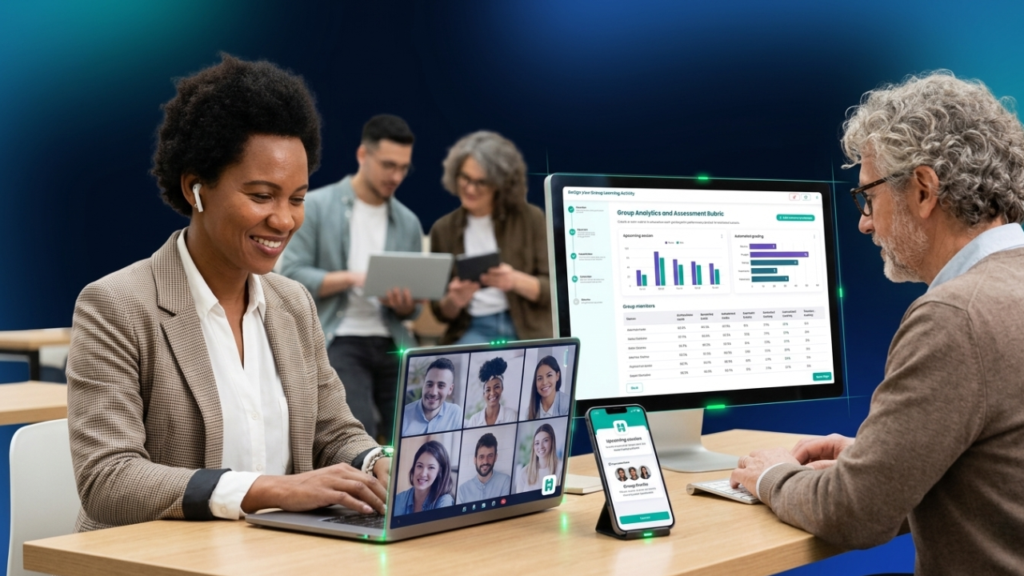
Before the session: Learning designers define the activity once, the objectives, the structure, the prompts, and the assessment rubric. The system handles deployment directly within the LMS. Learners see available time slots, choose what works for them, and receive automated reminders. Group formation happens without staff involvement. No scheduling spreadsheets. No email chains.
During the session: Learners enter a structured, facilitated conversation. An AI facilitator guides the group through the activity, ensuring equitable participation, keeping discussion anchored to the learning objective, drawing out contributions from quieter participants, and preventing any single voice from dominating. The experience is not a chatbot interaction — it is a moderated group conversation that feels like a well-run seminar, accessible from desktop or mobile, available whenever the group is ready to meet.
After the session: Each learner receives immediate, rubric-aligned feedback and assessment. Grades flow automatically into the LMS gradebook. Educators can access session transcripts, participation metrics, engagement and satisfaction data, and performance analytics across individuals and cohorts. What used to require a facilitator to observe, recall, and manually report is now captured systematically, every time.
This Is Exactly What Human2Human Is Built For
H2H Connect is Human2Human’s answer to the peer learning scaling problem. It is not a video conferencing tool with a discussion guide attached. It is a purpose-built system for delivering structured, AI-facilitated small-group learning that produces measurable outcomes — without the logistical complexity or facilitation costs that have historically made this kind of experience impossible to scale.
Scheduling, group formation, reminders, and rescheduling are handled automatically. The AI facilitator runs each session consistently, regardless of cohort size or time zone. Assessment and feedback are generated in real time. And the evidence produced — participation data, engagement patterns, transcript records, performance metrics — gives institutions something they have rarely had in asynchronous learning: genuine visibility into how peer interaction actually unfolded.
The goal is not conversation for its own sake. It is visible learning through guided human interaction. That distinction matters. Many tools can connect learners. Far fewer can ensure that what happens between them actually produces evidence of thinking, collaboration, and growth.

This Is Exactly What Human2Human Is Built For
The programs that are giving up on peer learning online are not wrong to be frustrated. The existing approaches are genuinely difficult to execute well at scale, and the failure modes are predictable and demoralizing. Facilitators burn out. Learners disengage. Staff spend enormous effort on coordination and still get inconsistent results.
But the solution to a broken delivery model is not to abandon the underlying idea. The research on why peer learning matters has not changed. What has changed is the availability of tools capable of addressing the orchestration challenge that has always stood in the way.
Learners learn better with other people. That was true before online education existed, and it remains true now. The question is no longer whether to make peer learning work at scale. It is whether institutions are willing to build the infrastructure to finally deliver on a promise they have been making for years.
Human2Human.ai helps online programs turn active learning into measurable evidence. H2H Connect replaces fragile peer learning formats with structured, AI-facilitated small-group experiences that scale — without additional staff, scheduling overhead, or loss of learning quality.