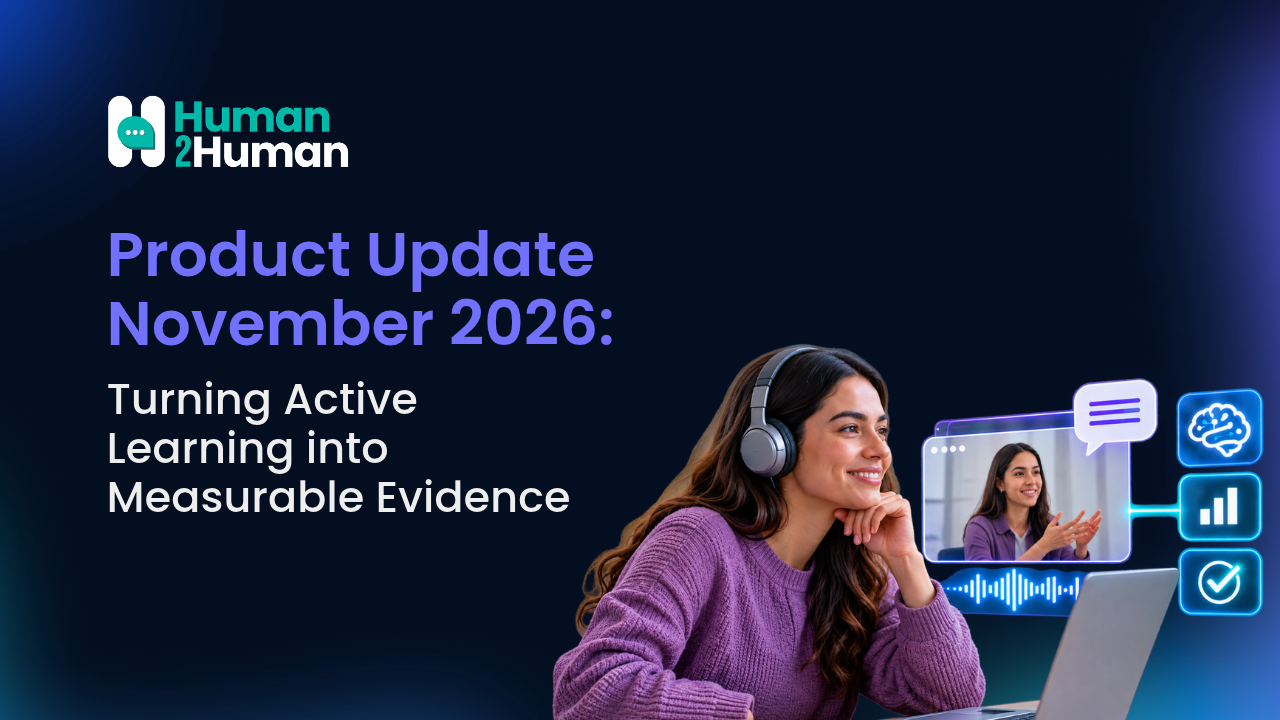
Online education solved the challenge of scaling content years ago, but it left the scale of thinking untouched. When human interaction fails to scale, learning becomes passive and isolating. Compounding this, generative AI has dismantled the traditional assessment model: written essays are easily outsourced, discussion forums lack authentic engagement, and institutions find themselves navigating a “data desert” where the learner’s actual reasoning remains invisible.
At Human2Human (H2H), our goal is neither to automate the learner nor to mass-produce generic answers. We use AI to orchestrate learning processes and activate critical thinking at scale
To support that mission, our platform continues to evolve. Here is an overview of the key product enhancements and architectural upgrades delivered over the past few months:
1. Infrastructure & Integrations: H2H Where Learning Already Happens

H2H is not designed to replace an institution’s tech stack. Instead, it functions as an active learning layer embedded directly within it
- Official Plugin on the Moodle Marketplace: A native integration is now available via marketplace.moodle.com. Administrators can connect their platform once through an intuitive, guided onboarding flow. Faculty can then embed H2H activities directly into their courses with a single click—no manual code injection, API keys, or complex configurations required.
- LTI 1.3 Certified Integration: We upgraded our core architecture to LTI 1.3, ensuring secure, standardized, turnkey compatibility with leading enterprise LMS platforms, including Canvas and Open edX.
- Private, LMS-Exclusive Access: Institutions can now restrict activities strictly to enrolled learners accessing via LTI. When this flag is enabled, public direct links are disabled, preventing unverified access outside the official cohort roster.
2. Learner Experience: Fluidity, Academic Integrity, and Verifiable Evidence
We redesigned the learner experience to eliminate operational friction while reinforcing the validity and authenticity of every interaction.
- Persistent Unified URL: The entire lifecycle of an activity—from pre-session context and prep materials to attempt histories and rubric breakdowns—is housed under a single, persistent link. The UI dynamically adjusts its state to match the user’s progress while preserving clean OpenGraph metadata when links are shared.
- Integrity Defenses & In-Session Webcam Support: For voice-facilitated sessions, learners can turn on an optional on-screen webcam feed. This serves as an effective deterrent against third-party AI proxy tools (such as real-time voice synthesis reading AI-generated answers).
- Tamper-Proof, Digitally Signed PDF Transcripts: Learners and instructors can export a timestamped transcript of their dialogue immediately after an activity concludes. Each document features a cryptographic signature to prevent post-session tampering, delivering a verifiable record of the student’s real-time cognitive reasoning.
- Configurable Attempt Modes & Progress Tracking: Instructional designers can toggle between formative practice (offering configurable or unlimited retries) and strict summative assessment (single-attempt mode). In practice mode, learners unlock an iterative progress graph tracing their growth across attempts.
- Live File Uploads: During guided conversations with the AI facilitator, learners can upload supporting files, case analyses, or reference documents to ground and contextualize their arguments.
3. Advanced & Semantic Analytics (Explore)
One of our most significant leaps forward is converting qualitative, conversational interactions into structured, actionable intelligence for instructional teams and academic directors.
- Four-Dimensional Analytics Dashboard: Cohort metrics are now organized into four targeted, exportable reporting panels: Attendance, Engagement, Performance, and Satisfaction.
- Granular Time-Series Filtering: Dynamic date-range filters allow programs to segment analytics by specific modules, terms, or historical cohorts.
- Semantic Analytics (“Explore”): We integrated a natural-language query engine that runs directly across all cohort dialogue transcripts. Instructors can query the dataset to uncover common misconceptions, recurring themes, or emerging stances on complex case studies. The engine synthesizes answers while maintaining clear citations and traceability back to the underlying conversational evidence.
- Null-Session Metric Protection: To protect cohort averages from statistical skew, the evaluation engine automatically skips grading if a session is abandoned prematurely or lacks meaningful interaction. This prevents artificial zeroes from contaminating gradebooks and immediately prompts the learner for technical feedback.
4. Instructional Design & Pedagogical Governance
- Modular, Step-by-Step Design Assistant: The AI instructional authoring assistant now supports iterative revisions. Designers can review, accept, or reject specific modifications suggested by the AI before saving, lock down activity time constraints, upload source documentation to generate prompts, and calibrate rubrics visually.
- Version History & Rapid Duplication: Full revision tracking allows teams to roll back edits instantly. Activities can also be cloned in one click to deploy variations across languages, terms, or distinct learner segments.
- Expanded Voice Engine Selection: We introduced six natural-sounding Spanish voice profiles (covering Colombian and Mexican variants in both feminine and masculine tones) alongside an expanded portfolio of English voices to elevate conversational authenticity.
- Blind Evaluation Mode (Hidden Grades): Designers can choose to run rubric-aligned grading exclusively in the background to inform faculty dashboards without displaying numeric grades to students—ideal for low-stakes, high-reflection scenarios.
5. Frictionless Onboarding & Access
- Guest Demos with “Claim Account” Flow: We minimized onboarding friction for first-time evaluators. Prospective users can complete a live simulation as an anonymous guest and subsequently claim their workspace by entering their institutional email to receive a passwordless verification code. The completed activity, session dialogue, and facilitator metrics port directly into their newly created environment.
- Passwordless Authentication: Streamlined access via Google Sign-In and secure email Magic Links combines effortless entry with enterprise-grade security standards.
- Transparent Pricing Architecture: We maintain an always-available Design & Sandbox Mode that includes 500 facilitation minutes for course authoring and testing, complemented by a self-serve baseline plan at $79/month providing 2,000 facilitation minutes.
What’s Ahead on the Horizon

Our engineering and pedagogy teams are currently developing:
- Multi-modal activity phases integrating synchronous video playback with embedded micro-assessments.
- An automated, pre-deployment instructional quality assurance validator.
- Deeper native ecosystem connectors for specialized edtech environments.
We don’t automate the learner; we activate their thinking.
Discover why leading programs are replacing passive discussion boards and vulnerable essay prompts with an active reflection layer at scale