Most conversations about artificial intelligence in education remain focused on incremental efficiency: automating email drafts, generating multiple-choice quizzes, detecting essays written by chatbots. In this framing, AI is a digital assistant that lightens routine academic labor.
Recently, I joined a conversation between Juan Camilo Montoya, cofounder of human2human.ai and Ben Nelson, founder and CEO of Minerva Project. For over a decade, Minerva has operated as a counter-model to traditional higher education, built on synchronous Socratic seminars grounded in the science of active learning.
Over forty minutes, Nelson challenged many of the prevailing assumptions about generative AI in education and work. His diagnosis of where human utility is heading, and of how prepared the current educational system is for that shift, was direct and unsentimental.
This paper synthesizes the four core arguments from that dialogue, which I believe every founder, university provost, and educator should consider.
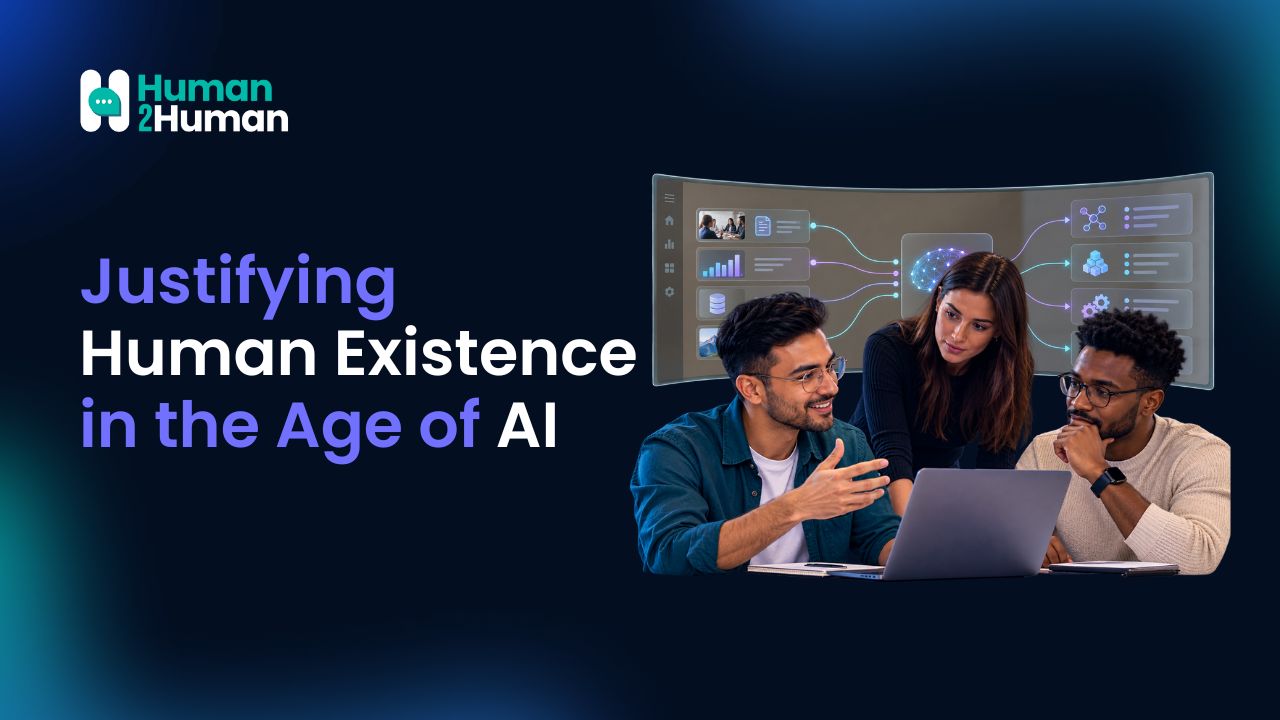
1. The Existential Flip: From “How Does It Help Me?” to “How Do I Justify My Existence?”
The prevailing discourse in enterprise and education treats AI as a co-pilot: the human remains the driver and the machine is the navigator. Nelson considers this framework fundamentally flawed:
“The question is no longer: What can AI do for me to make my life better? It is: What can I do to justify my existence in the age of AI?”
BEN NELSON · CEO, MINERVA PROJECT
He illustrates the shift with autonomous vehicles. Once driverless cars demonstrate accident rates a fraction of those of human drivers, Nelson expects governments will not merely permit them but eventually outlaw human driving. The ethical logic becomes hard to resist: why accept preventable harm to bystanders in order to preserve human control, when an autonomous system is demonstrably safer?
In Nelson’s view, the same calculus will reach the enterprise. If an executive or analyst consistently introduces cognitive bias, delay, and error into a company’s strategic pipeline while an agentic model delivers cleaner, cheaper, and faster outcomes, boards will eventually ask why a human is in that loop at all.
NELSON’S TIMELINE FOR THE AUDIT OF KNOWLEDGE WORK
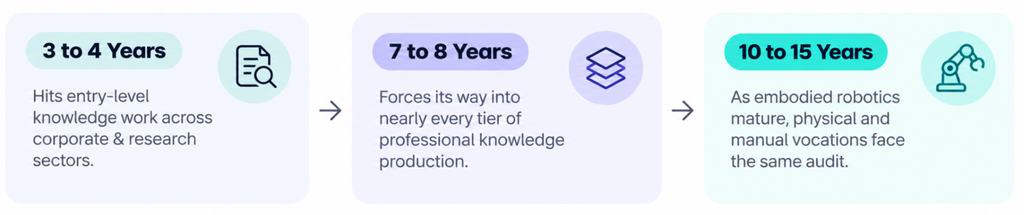
The implication, as Nelson frames it: if your daily output can be replicated or surpassed by a machine, an appeal to human relevance is not enough. Professionals must offer a distinct, non-fungible cognitive value add.
2. The 100x Threshold: Why Legacy Higher Ed Is Testing the Wrong Things

If AI can summarize research, debug code, draft briefs, and analyze datasets at near-zero marginal cost, what is a traditional university degree worth?
Nelson’s answer is unequivocal: the threshold of value an educational institution must provide to a student has risen by at least two orders of magnitude (100x).
Much of the concern in faculty circles centers on cognitive offloading: students using tools such as Claude or ChatGPT to write lab reports or solve problem sets. Nelson believes this anxiety misses the point:
“The concept of ‘Oh, you’re using AI for cognitive offloading and now you can’t pass your chemistry test’ is completely irrelevant. The chemistry test was never the right measure to begin with.”
BEN NELSON
If an assessment can be solved, synthesized, or spoofed by a neural network in seconds, it never measured authentic, transferable human intellect. It measured pattern recognition and information retrieval, tasks that computers were built to perform well.
Education only justifies its cost today if it trains students in high-ambiguity decision making, spontaneous ethical deliberation, multi-variable systems thinking, and the defense of original hypotheses. Everything else is context or background on which higher order thinking must lie.
3. The University Realpolitik: Why “Institutional Visions” Fail
Minerva is globally recognized because it operates on a single, holistic blueprint: every undergraduate course across four years reinforces the same foundational cognitive frameworks (Habits of Mind and Foundational Concepts), delivered on a proprietary digital platform (Forum).
Yet Nelson was candid about how rare that model is across the rest of higher education:
“We believe deeply in the institutional-wide view. Practically no other university in the world believes in it. To make that work requires an enormous change management effort that almost no institution will undergo for the sake of a software tool.”
BEN NELSON
In practice, universities do not buy grand institutional transformations from software vendors. They buy point solutions that solve concrete, localized problems for department chairs and individual instructors.
4. The EdTech Defensibility Trap: The Big Tech Steamroller
For founders and executives building educational technology, Nelson offered a structural warning that many venture pitch decks overlook:
“Anthropic and OpenAI are constantly releasing more native embedded functionalities and chopping the legs off anybody trying to build a superficial functional layer of AI. How do you defend your value?”
BEN NELSON
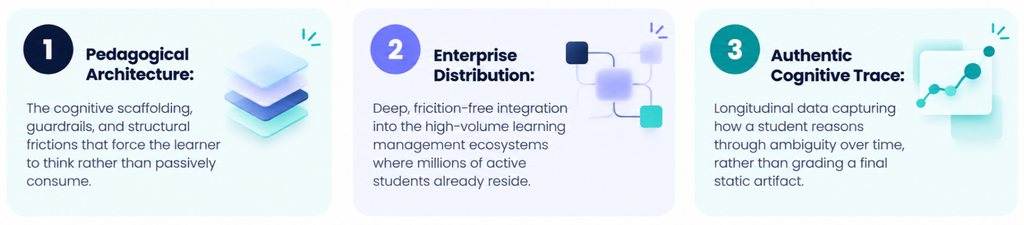
A product whose value lies in an interface wrapped around an API call to a frontier model has a short horizon, since foundation model providers tend to absorb such features into their next release. Durable value has to come from somewhere else.
THE THREE PILLARS OF DEFENSIBILITY IN LEARNING TECHNOLOGY
Nelson’s advice for product positioning in EdTech:
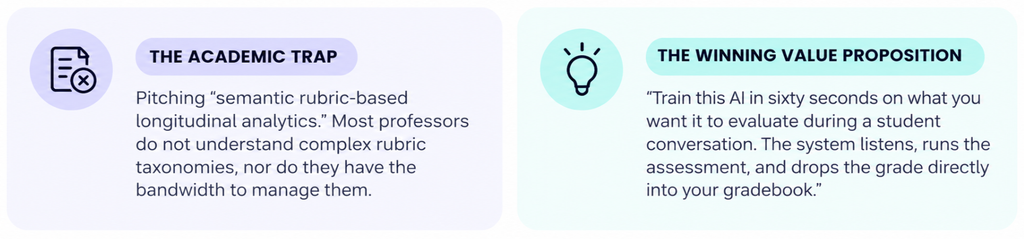
The takeaway: reduce academic jargon, remove operational friction, and deliver immediate, tangible utility to the classroom teacher.
The Last Frontier: Voice, Spontaneity, and Spoken Thought
One conviction emerged clearly from the dialogue: the era of asynchronous, written deliverables as proof of student learning is effectively over.
A submitted PDF, an essay, or a multiple-choice exam no longer carries a reliable cognitive signal. Each is too easy to outsource, automate, and sanitize.
What remains distinctly human, for now, is the spontaneous spoken voice. When a person must speak out loud, hesitate, defend a premise under Socratic pressure, resolve a contradiction, and articulate a mental model in real time without a screen to hide behind, authentic intellect becomes visible.
The challenge for the next generation is not identifying which administrative tasks can be handed to software. It is answering the question Nelson leaves us with:
“When the machine can do almost everything, what do you bring to the room that justifies your presence in it?”
BEN NELSON
Our Perspective

Nelson’s arguments point to a common implication for any organization building or adopting learning technology: durable value will come from designing for human cognition, not around it. This is the premise behind human2human.ai, which brings real-time conversation and peer learning to online programs: oral exams, role plays, debates, defenses, and guided reflection, facilitated by AI for every learner, whenever each is ready. Three principles follow:
- Make reasoning visible. Spoken, spontaneous conversation is where a learner’s thinking shows. Oral exams, defenses, and debates reveal how people reason, which a final written deliverable cannot. The goal is to see the learning process, not just the score.
- Scale the conversations that need a facilitator. Role plays, interview practice, and guided reflection have always required a human in the room. AI facilitation makes them available to every learner on their own schedule, designed once and run at scale.
- Keep human interaction at the center. Technology should amplify the conversation between people, not substitute for it. Learning design that makes people think and engage is a differentiator that features alone cannot replicate.
At human2human.ai, these are the questions guiding how we build, and we look forward to exploring them with institutions, educators, and partners.
About this publication: This paper synthesizes a private executive dialogue between Ben Nelson (Founder & CEO, Minerva Project) and Juan Camilo Montoya, cofounder of human2human.ai and edunext.co.