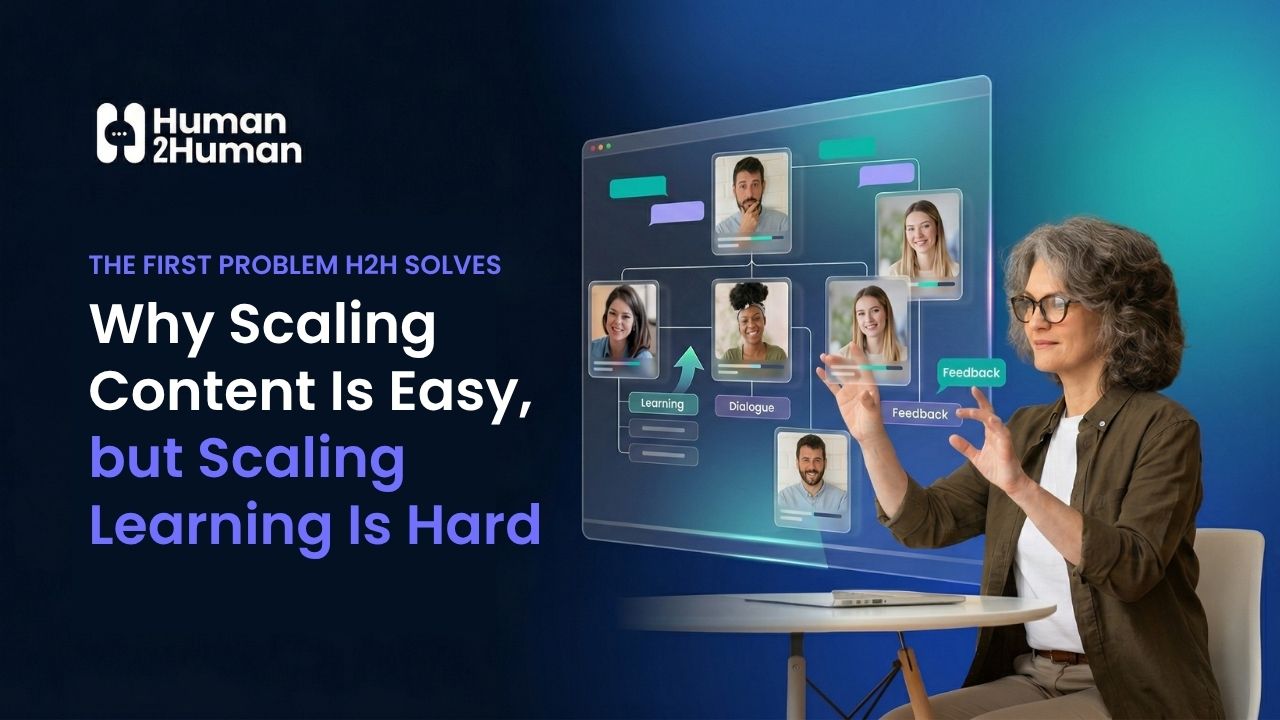
The First Problem H2H Solves: Why Scaling Content Is Easy, but Scaling Learning Is Hard
Online education has transformed access to knowledge.
Universities, professional training programs, and corporate learning teams can now reach thousands of learners simultaneously through digital platforms. Videos, readings, quizzes, and automated grading allow courses to run at a scale that was impossible in traditional classrooms.
From an operational perspective, content now scales effortlessly.
But this success hides a deeper challenge.
Scaling the learning experience is much harder.
The hidden trade-off in online education

Why the problem is becoming more urgent
This challenge has existed since the early days of online learning, but recent technological changes have made it significantly more visible.
Generative AI tools can now produce essays, discussion posts, and other written assignments in seconds. Tasks that once required sustained effort and reflection can now be completed with minimal engagement. As a result, many traditional forms of assessment are rapidly losing their ability to demonstrate genuine learning.
For instructors and program teams, this creates a growing visibility problem. Institutions can easily track completion rates, assignment submissions, and final grades, but they often cannot see how learners actually thought through a problem, reflected on their decisions, or engaged with ideas during the learning process.
When the learning process itself becomes invisible, it becomes much harder to evaluate understanding, improve course design, or demonstrate the value of a learning program.
At the same time, expectations around online education are changing. Learners increasingly expect interactive, collaborative, and intellectually stimulating experiences. Programs that fail to provide these elements risk feeling interchangeable in a competitive market where many courses offer similar content.
The real challenge: scaling the learning process
The fundamental challenge is not a lack of educational content. In fact, there is more content available to learners today than at any time in history.
The real difficulty lies in scaling the learning process itself.
Deep learning requires more than exposure to information. It requires learners to actively process ideas, reflect on their understanding, articulate their reasoning, and engage with others’ perspectives. These processes help learners move beyond passive consumption and develop true conceptual understanding.
Traditionally, these experiences are facilitated by instructors, conducted in small groups, and involve case analysis and reflective assignments. In physical classrooms or small seminars, instructors can guide these interactions naturally. However, reproducing these experiences in large online programs is far more challenging.
As enrollment grows, institutions face increasing pressure to maintain quality without dramatically increasing instructional costs. Facilitating rich discussion or providing individualized feedback for hundreds or thousands of learners quickly becomes operationally unsustainable.
This creates a structural tension within online education: programs must deliver meaningful learning experiences while maintaining the scalability and efficiency that digital education promises.
Why this matters
Learning is not simply about exposure to information.
Decades of research in the learning sciences demonstrate that people develop a deeper understanding when they actively engage with ideas. When learners are asked to analyze a situation, explain their reasoning, and consider alternative viewpoints, they move beyond memorization toward higher-order thinking.
Reflection helps learners connect new concepts with prior knowledge. Dialogue with peers exposes them to different interpretations and challenges assumptions. Articulating ideas forces learners to organize their thinking and clarify their understanding.
These processes are inherently human and social.
When online education fails to support them, learning risks becoming a passive activity centered around consuming content rather than engaging with ideas.
The starting point for a new approach
Human2Human was created to address this exact challenge.
Instead of focusing solely on scaling content delivery, Human2Human focuses on scaling the learning process itself. The goal is to make reflection, reasoning, and peer interaction possible even in large online programs, without requiring significant increases in instructor workload.
Because the future of online education will not be defined by how much content we can distribute.
It will be defined by whether we can preserve the depth, interaction, and human engagement that make learning meaningful—even at scale.
Do you want to learn and explore more about Human2Human.ai? Contact us.